What Is SOC 2 Automation? How to Automate Your SOC 2 Compliance
SOC automation can take SOC 2 from a spreadsheet-heavy project to a system that runs in the background. But software alone won’t get you through the audit.
If you run a SaaS company, SOC 2 usually appears at the worst possible time.
A prospect wants your SOC 2 report before signing. Your engineering team is focused on shipping. Your operations team has ten other priorities. Then someone opens a spreadsheet and starts asking for screenshots.
This is where SOC 2 automation comes in.
Platforms such as Vanta, Drata, and Thoropass can automate evidence collection, monitor controls, track compliance tasks and keep your security program audit-ready. The right setup can save significant time.
But there is a catch: automation handles the repetitive work. Someone still needs to decide what your company should do, fix the gaps and make sure the controls actually work.
Here’s what that looks like.
What is SOC 2?
SOC 2 is a security framework developed by the American Institute of CPAs (AICPA). It helps companies demonstrate how they protect customer data and manage their security controls. The framework covers five Trust Services Criteria: security, availability, processing integrity, confidentiality and privacy.
For SaaS companies, SOC 2 has become a common enterprise sales requirement.
A prospect’s security team may ask:
- Do you have access controls?
- How do you handle employee onboarding and offboarding?
- Are customer systems monitored?
- How do you respond to security incidents?
- Do you test your systems for vulnerabilities?
- Can you prove your controls have been operating effectively?
Your SOC 2 report gives them an independent assessment of those controls.
There are two main types.
- SOC 2 Type 1 looks at whether your controls are suitably designed at a specific point in time.
- SOC 2 Type 2 goes further. It evaluates whether those controls operated effectively throughout an observation period, usually three to twelve months.
For many SaaS companies, Type 2 is the end goal because enterprise customers often want evidence that security processes work consistently over time.
How long does SOC 2 take?
The answer depends on your starting point, the report you need and how quickly your team can close security gaps.
A Type 1 can take roughly 3–6 months from preparation through the final report. A Type 2 can take 6–15 months, largely because of the required observation period.
The audit itself is only part of the timeline. The bigger job is getting your company ready.
You may need to:
- Define what systems and teams are in scope.
- Identify missing controls.
- Write and approve security policies.
- Configure access controls.
- Run security awareness training.
- Complete vulnerability scanning and penetration testing.
- Establish incident response and business continuity processes.
- Collect evidence.
- Monitor controls.
- Work with your auditor.
This is why starting with the audit date is a mistake. Start with the gaps.
What is SOC 2 automation?
SOC automation uses software to handle repetitive compliance work and continuously monitor your security controls.
Think of it as the operating system for your compliance program. A SOC automation platform can connect to the systems you already use — cloud infrastructure, identity providers, HR software, code repositories and other business tools.
From there, it can automatically collect evidence and test controls. Instead of asking an engineer for a screenshot of an AWS configuration six months from now, the platform can pull the relevant information automatically.
Instead of keeping a spreadsheet of compliance tasks, your team can see which controls are passing, which are failing and who owns each remediation task.
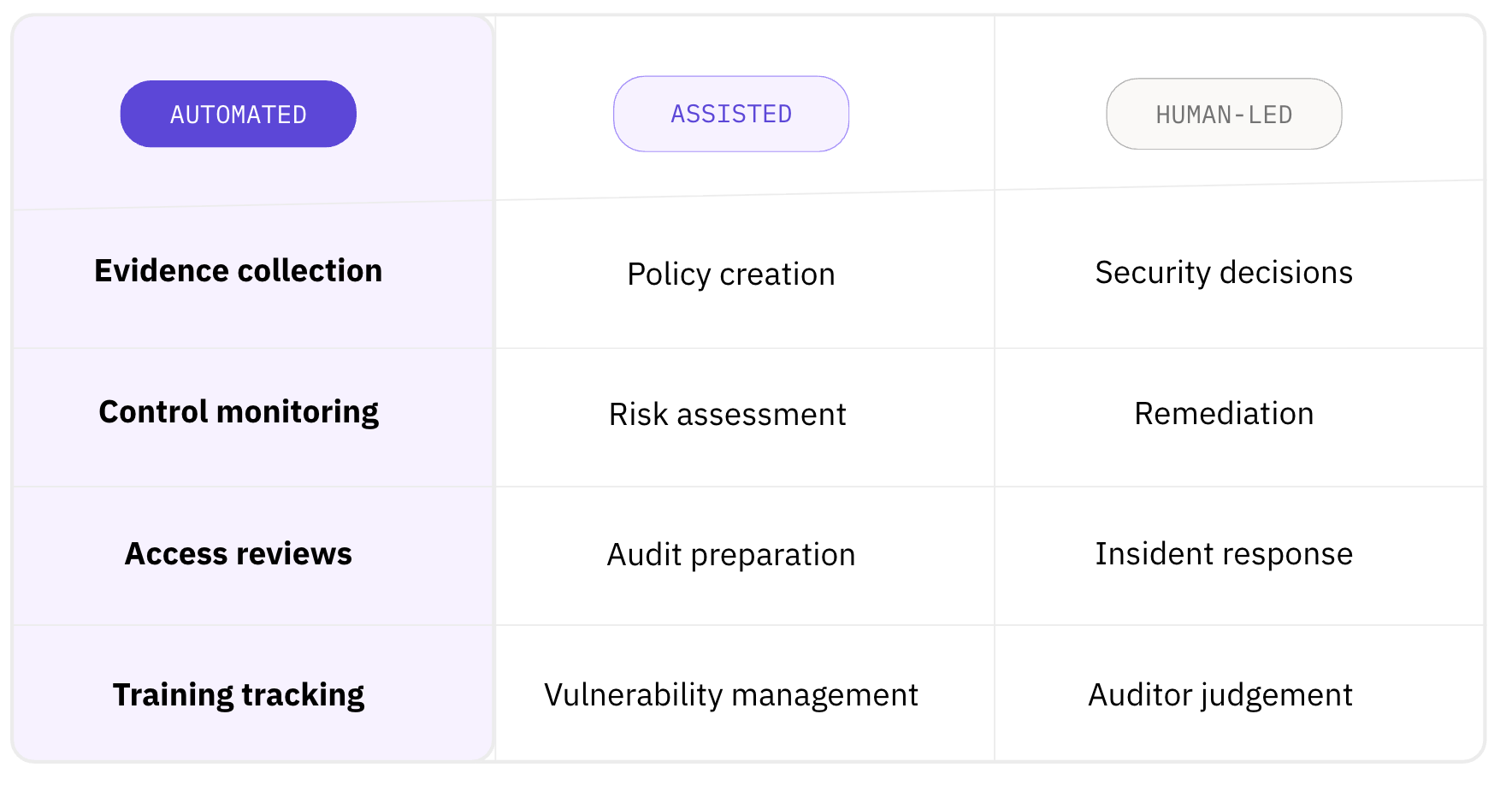
Common automated tasks include:
- Evidence collection
- Control monitoring
- Risk tracking
- Security training
- Access reviews
- Policy management
- Compliance task assignment
- Cloud configuration checks
- Third-party application monitoring
- Audit evidence organisation
Vanta, for example, connects to cloud, identity, code and security tools and continuously monitors controls. Drata similarly automates evidence collection and maps evidence to SOC 2 controls.
Thoropass takes a broader approach, combining compliance automation with the audit and attestation process in one platform.
What can’t SOC 2 automation do?
Automation can identify a missing control. It cannot magically make the control effective. Software can tell you that an employee still has access to an application. Someone still needs to remove that access.
It can identify a policy requirement. Someone still needs to approve and enforce the policy.
It can flag a vulnerability. Your engineering team still needs to fix it.
It can organise audit evidence. An independent auditor still needs to review it.
The goal is simple: automate the evidence and monitoring so your people can focus on the security work that actually requires judgment.
How to automate your SOC 2 compliance


There are three practical routes for a SaaS company.
Option 1: Vanta
Vanta is built around automated compliance monitoring and evidence collection.
You connect your existing technology stack, configure your SOC 2 scope and work through the resulting tasks. Vanta continuously tests controls and surfaces issues that need attention.
Best fit: SaaS companies that want a mature compliance platform with broad integrations and continuous monitoring.
Option 2: Drata
Drata focuses heavily on automated evidence collection and control monitoring.
It connects with your technology stack, maps evidence to controls and gives your team a central place to track readiness. It also provides an audit workspace for collaboration with your auditor.
Best fit: Teams that want detailed compliance workflows and strong evidence automation.
Option 3: Thoropass
Thoropass combines the compliance platform with audit and attestation services.
The platform brings scope, evidence, audit requests, reviews and milestones into one workspace. Its model is designed to reduce the handoffs between compliance software and the audit process.
Best fit: Companies looking for an integrated compliance and audit experience.
What’s the hardest part of SOC 2?
For most companies, the hardest part is turning security requirements into consistent operating processes.
The software is usually the easy bit.
The difficult questions are:
- Who owns each control?
- What happens when someone joins the company?
- What happens when someone leaves?
- How often do you review access?
- Where are security incidents documented?
- How do you prove employees completed training?
- What happens when a control fails?
- Can you produce evidence that shows the process actually happened?
The company needs to follow the policy and generate evidence that proves it. That is also why Type 2 can be challenging. The auditor is looking at operating effectiveness across a period of time.
Where do companies get SOC 2 wrong?
1. Buying the software first
A compliance platform is a tool. It is not your compliance program. Connect Vanta, Drata or Thoropass to a messy environment and you get a very organised view of a messy environment.
Start with scope and a gap assessment.
2. Treating SOC 2 as an engineering project
Engineering will own some of the work. Security, HR, operations and leadership also have roles. SOC 2 touches the whole company.
3. Writing policies nobody follows
Copying policy templates into a folder creates documentation. It doesn’t create a security program. Your policies should describe processes your company can actually operate.
4. Waiting until the audit to collect evidence
This creates the classic SOC 2 scramble. Automation solves much of this problem by collecting evidence continuously.
5. Choosing the wrong scope
A wider scope means more systems, controls and evidence. A narrower scope can make the project easier to manage.
Your scope should reflect the product and the customer requirement. Your auditor should be involved early.
The better approach: automate the work, outsource the complexity
For a busy SaaS founder, SOC 2 should not become a second job. Cloudsapio helps companies build and run the security program behind their SOC 2.
We can help with the gap assessment, policies, controls, remediation, evidence, security testing and audit preparation. We also work with compliance platforms including Vanta, Drata and Thoropass. That means you can use the automation platform that fits your business while having an experienced security team handle the work around it.
Cloudsapio offers three ways to engage:
- Security Sprint: assess your current security posture, identify gaps and create a prioritised remediation roadmap.
- Strategic vCISO: ongoing security strategy, compliance guidance, policy reviews, vendor reviews and customer security questionnaires.
- Leader vCISO: hands-on security leadership, remediation support, audit preparation and incident response leadership.
The objective is simple: get your SOC 2 done without pulling your engineers away from the roadmap.
Get started with cloudsapio
If SOC 2 is sitting on your sales pipeline, start with a 30-minute discovery call.
We’ll look at where your security program is today, what your customers are asking for and the deadline you are working toward.
From there, we can tell you what needs to happen, which parts can be automated and where you need hands-on security support.
If Cloudsapio is the right fit, we’ll build the plan with you.
Ready to move faster?
Too much to do,
too important to ignore.
Start with a 30-minute discovery call. If we're not the right fit, we'll tell you and point you in the right direction. If we are, we'll leave the call with a clear plan to get you up and running.